Pocket Sunshine is a project that is quite the contrary to the dark, philosophical themes of Carbo Vivus that lead the listener to contemplate. Instead, Pocket Sunshine features wholesome electronic songs with experimental twists such as microtonality, that aim to calm and brighten up the day of the listener. This is reflected in the name of the project: It is called Pocket Sunshine, because the music, which you listen to from the phone in your pocket, aims to bring a little bit of light into dark days.
Releases
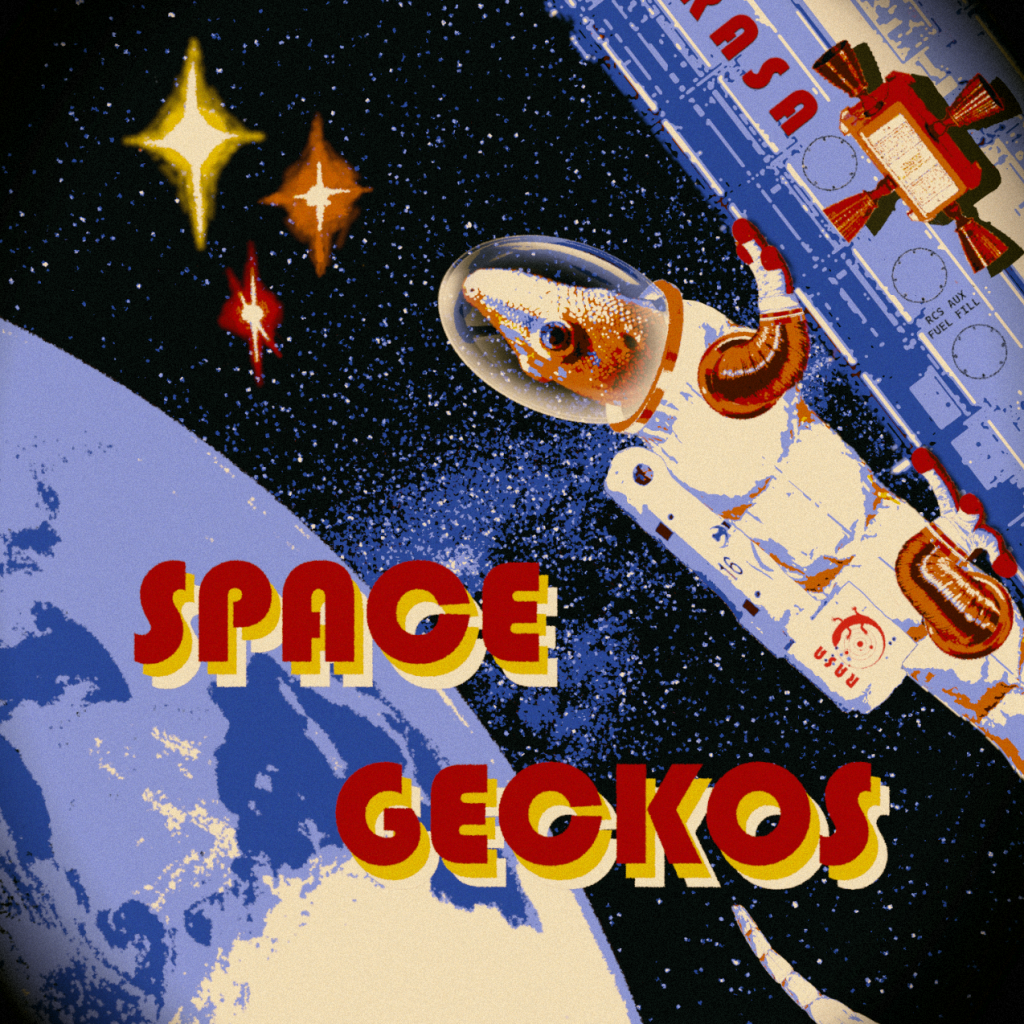
Space Geckos
I got the idea for this song from a painting of a gecko in a space suit that a good friend of mine painted. The idea was a cute, kind of vintage sounding track, that told the interstellar journey of 3 geckos to the star system alpha centaury, which is the closest to our solar system. I wanted to incorporate some mission control audio similar to that of the apollo missions and some rocket and spaceship sounds that bring the story together and are an extra little treat for space nerds like me 🙂 Speaking of space nerds, i needed some extra voices for the prelaunch status check, so i asked my space nerd friends if they would like to give the geckos a go for launch and they agreed and are now eternalized in the track!
Conciousness Conjecture [12/11 EDO]
(Space Geckos Part 2)
During the long, interstellar flight, the Geckos are in a coma, which is a fascinating state of mind. In a coma, the geckos are in between two worlds, the world they call reality and a sort of coma dream world. This dream world can feel just as „real“ as „reality“ itself, and there have been many humans waking up from a coma grieving there coma life that includes friends, family and so on, knowing that they cannot ever return. This phenomenon really questions conciousness itself, since we think of coma patients as being unconcious. This conundrum is musically explored in this little interlude between the geckos setting off on their journey and arriving at their destination.
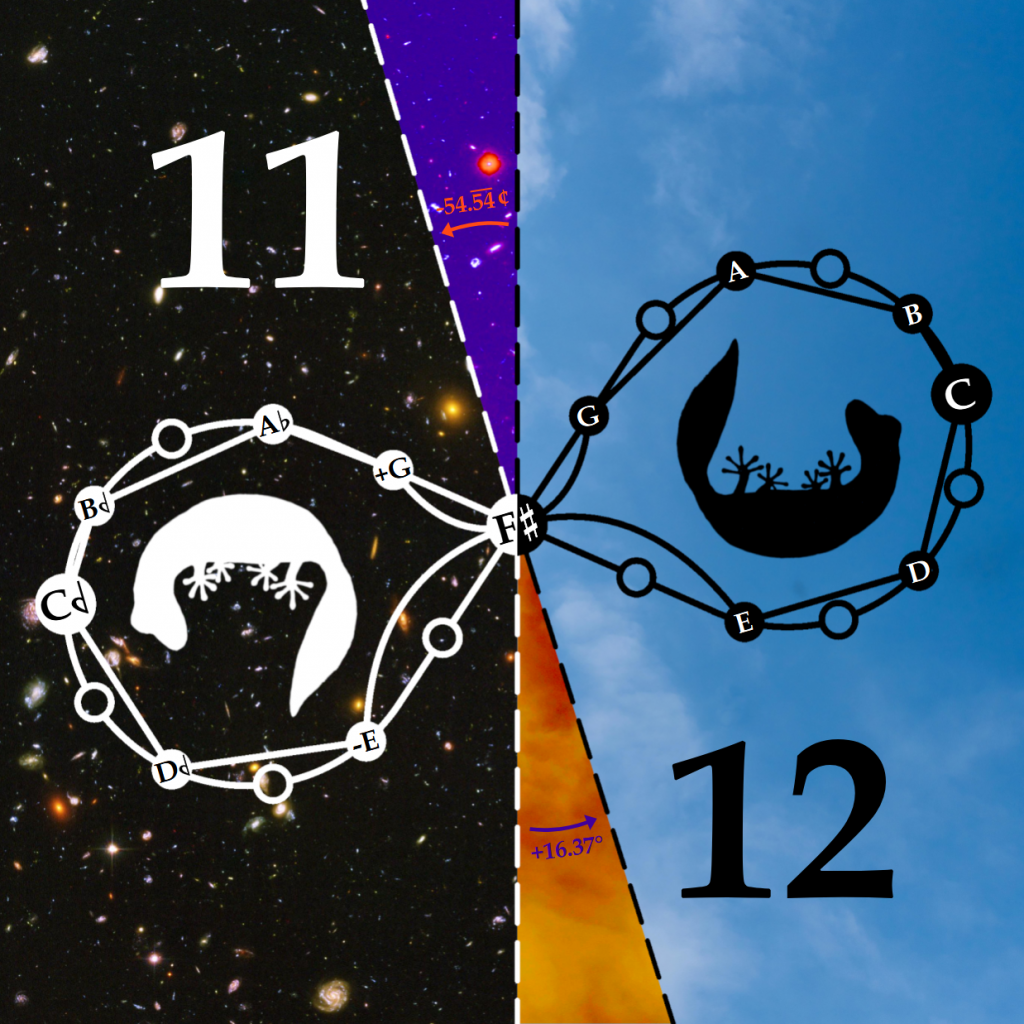
For this song i „invented“ a new bit of music theory. The song is written in lydian in both 12 and 11 EDO, wheras the two systems are coupled via the augmented 4ths. Since the augmented 4th in 11 EDO is quite a bit higher at 654.55 cents and can almost be considered a low perfect fifth, the whole 11 EDO system has to be shifted down by the difference which is 654.55 – 600 cents = 54.55 cents. This causes the root note of the 11 EDO system to be pretty much a quarter tone flat compared to the 12 EDO system.
The chord progression wanders back and forth between the two worlds, starting at the 12 EDO „reality“ and incorporating more and more notes from 11 EDO until the chords are pure 11 EDO. The same principle applies for going back to 12 EDO.
Also, the chord progression starts at a C chord (Cmaj7(add2)) and ends at F#m7(add11, add b13), to connect the first song (C minor) with the negative harmony (F# mixolydian) in the third song.
Lorem ipsum dolor sit amet, consectetur adipiscing elit. Ut elit tellus, luctus nec ullamcorper mattis, pulvinar dapibus leo.
Arrival [12/20 EDO]
(Space Geckos Part 3)
This is the final part of the 3 Song Space Geckos EP in which our 3 travellers finally awake from their long slumber in interstellar space. After they have passed their automatic wellness check, their hybernation capsule opens leaving them in a new star system almost 4 light years away from earth! In order to land on their target exoplanet Proxima Centauri b, they first have to slow down to get into an orbit around it so they can take their time selecting a suitable landing spot. When that is done, they fire up the retrothrusters again to enter the atmosphere of the planet in a calculated manner and eventually glide down to their destination. After safely touching down, everything is prepared for the first extravehicular activity (EVA) on an exoplanet and when everything is ready, the geckos can exit the spacecraft through the airlock, and after setting the first foot on alien soil the science can begin! And after over 4 years of scientific findings, the touchdown confirmation will have finally made it to earth, letting the people know that their travellers are safe after an eternity of anticipation.
If you are a careful listener, you might be able to keep track of these milestones of the journey!
This Song has a large exploration of music theory! First of all, the entire song is written in F# Mixolydian which is the negative harmony equivalent of C Minor scale used in the first Space Gecko Song. This is to contrast the two different worlds of the solar system and the alpha centauri system. Also, Mixolydian has kind of a happier, „we are almost there“ kind of feel to me. The negative harmony also makes it possible to bring back the melody of the first song with it having e very different vibe but still being recognizable, so that the EP becomes more cohesive.
Then, there are the xenharmonic scales: To achieve a new, alien sound, while still not wandering too far away from F# Mixolydian, i built a 10 EDO Mixolydian approximation. Thanks to its neutral third (360 cents) and neutral sixth (840 cents) it gets an eerie xenharmonic character that i absolutely love. In the finale of the song i subdivide 10 EDO into 20 EDO to get more harmonic variety, such as an additional, beautiful supermajor third (420 cents) as well as two kinds of major seconds and minor sevenths which are awesome to build some huge xen chords with tons of little varieties here and there!
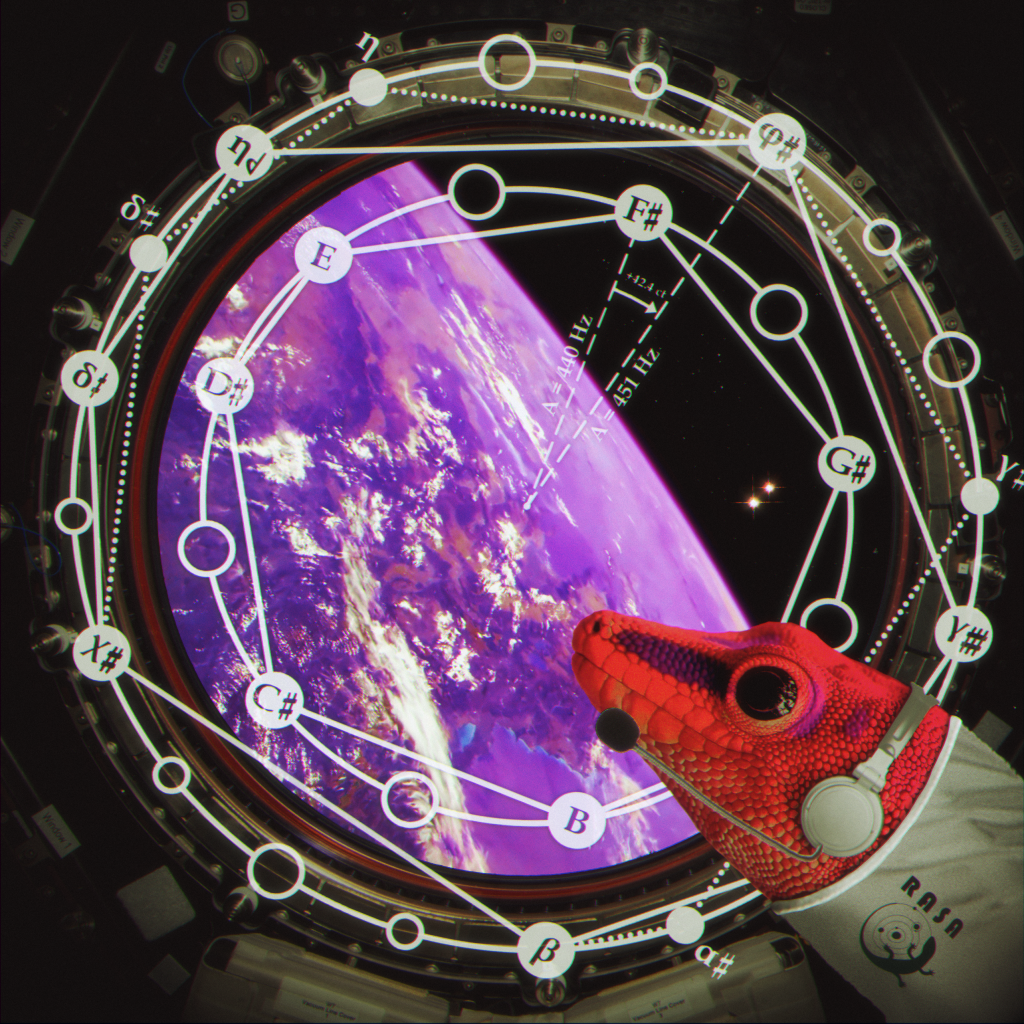
Not only do i switch between 12 EDO and 10/20 EDO in the song, but i also shifted the 10/20 EDOs base note (F#) to A = 451 Hz to make it just a little more alien sounding and to compensate for the 10 EDO Mixolydian sounding darker than the 12 EDO one. To not cause confusion, i labeled the 10/20 EDO notes with the phonetically closest greek letters (F# becomes Phi#, A# becomes Alpha# a.s.o.)
To modulate between the different systems, i used 2 different methods: First, i just hold a 12 EDO triad and slowly pitch shift the notes to the 10 EDO equivalent, which is a rather easy method. Towards the end of the song i used a clever method, where i have found a 12 EDO note in the Mixolydian scale that is also very close to the Nth harmonic of the 20 EDO root note (Phi#) which happens to be E7. Than i just ascend to that note and descend the harmonic ladder until i reach Phi#. Ta-Daa! I find this method quite elegant and sneaky and i will probably use it again in the future.
Rhythmically, there were also some interesting experiments. For example, the first section of the song is in 4/4 but the basslines rhythm is in 5/4 with it being periodically truncated after 3*5/4 + 1/4. And then, there is a cool metric modulation happening i the techno part. This part is in 5/4 and the arpeggios consist of 5 16th notes, fitting 4 arpeggios in one bar, giving a cool polyrhythm feel. The cymbals accent the beginning of these arpeggios and are used as the new reference beat when the techno kick gets high pass filtered and comes back at a lower tempo, now aligning with the arpeggios. So all in all, 5/4 at 138 bpm becomes 4/4 at 110.8 bpm with the 5 16th notes becoming quintuplets in the process.
The title art features two rings that display the two temperaments used in the song (12 and 20 EDO) and their pitch relationship to one another, with the outer 20 EDO ring being rotated slightly due to the modulation to A= 451 Hz. I used greek letter note names to avoid confusion with the A= 440 Hz 12 EDO notes.
Also, the planet outside of the window is supposed to be Proxima Centauri B, a planet orbiting our closest star in the habitable zone. In this fictional story, the planet developed life and has some sort of alien plants that use photosynthesis pathways that are more optimal for the stars red light light, giving them a dark purple hue. The two bigger stars next to the planet are an actual image of Rigil Kentaurus and Toliman, the closest stars to Proxima Centauri and they are placed on the image roughly like how the would actually appear in the night sky over Proxima Centauri b.
The window that our geckonaut is gazing through is actually an image of the ISS cupola.
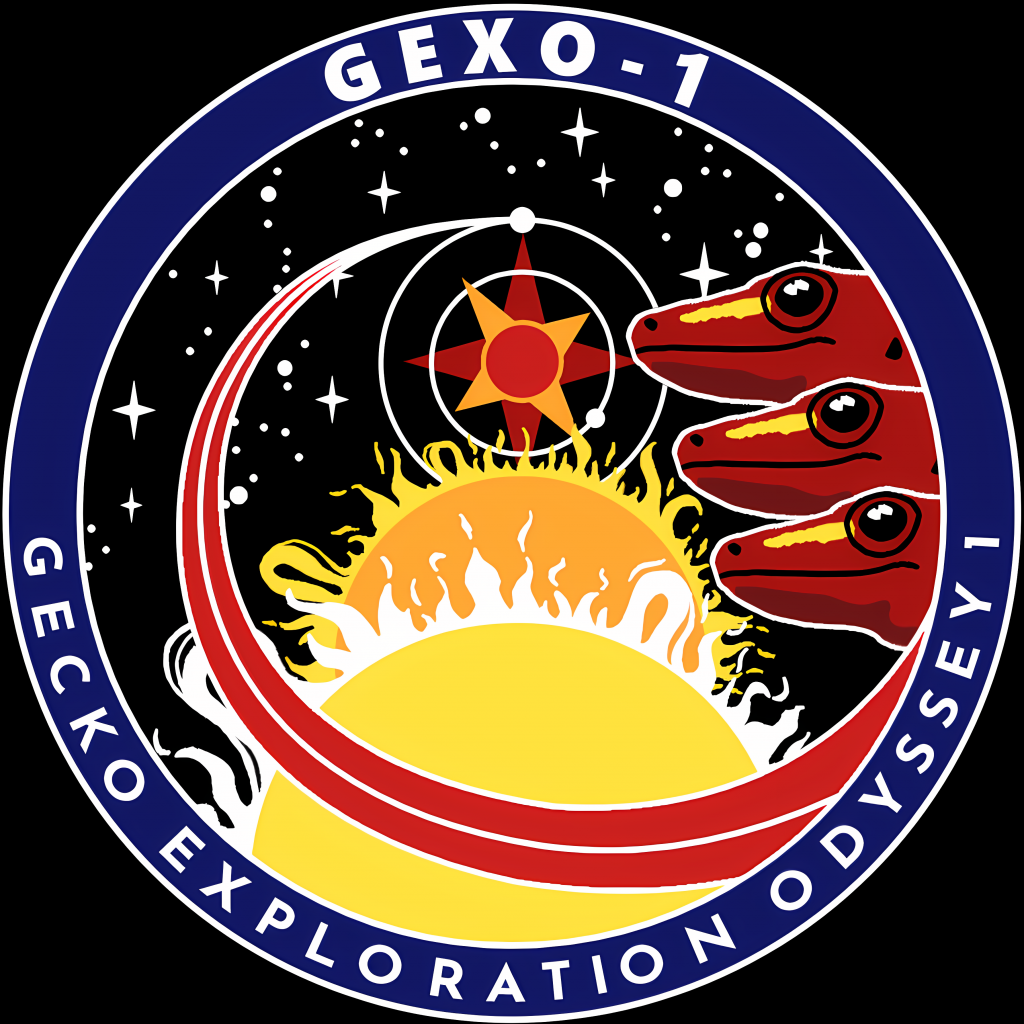
The Gecko Exploration Odyssey (EP)
The whole Space Geckos trilogy released as one EP. That is when i am done remixing/mastering the entire thing. But i haven’t started yet but i really wanted to make the cover art already because it’s a cute gecko mission patch!
This EP contains the whole Space Gecko Trilogy, from their launch from planet Earth, to low earth orbit and from there through a long interstellar journey in their hibernation pods to the exoplanet Proxima Centauri B. Fun Fact, the style of music changes through the album: While the first song, Space Geckos, has instrumentation based on music from the 80s, the last song, Arrival features late 90s instrumentation. This gap of around 15 years reflects the roughly 15 year long slumber the geckos have to go through, where they eventually wake up into an entirely new and different era of music!
Lorem ipsum dolor sit amet, consectetur adipiscing elit. Ut elit tellus, luctus nec ullamcorper mattis, pulvinar dapibus leo.
2222222222222222222222 [22 EDO]
I love house music and also the xenharmonic works of Brendan Byrnes, especially his album „Neutral Paradise“, so i wanted to combine those two since i couldn’t find any microtonal house and that’s how this quirky track was born. Just stereotypical, house formula elements but in 22 EDO and with some little twists added (i couldn’t help myself). It just became an absolute meme track so it deserved a meme title as well, since i but as many twos in there as i could think of XD
This track is completely in 22 EDO and marks the first fully xenharmonic track i made. I didn’t cling to any 22 EDO scales, the chords were built through pure vibe and love for whacky intervals. The chords often have these micro changes, that mix op their flavours in interesting ways. And of course i had to play them with a fat supersaw synth to give it a dreamy, retro like feel since house music does make me feel nostalgic in a way.
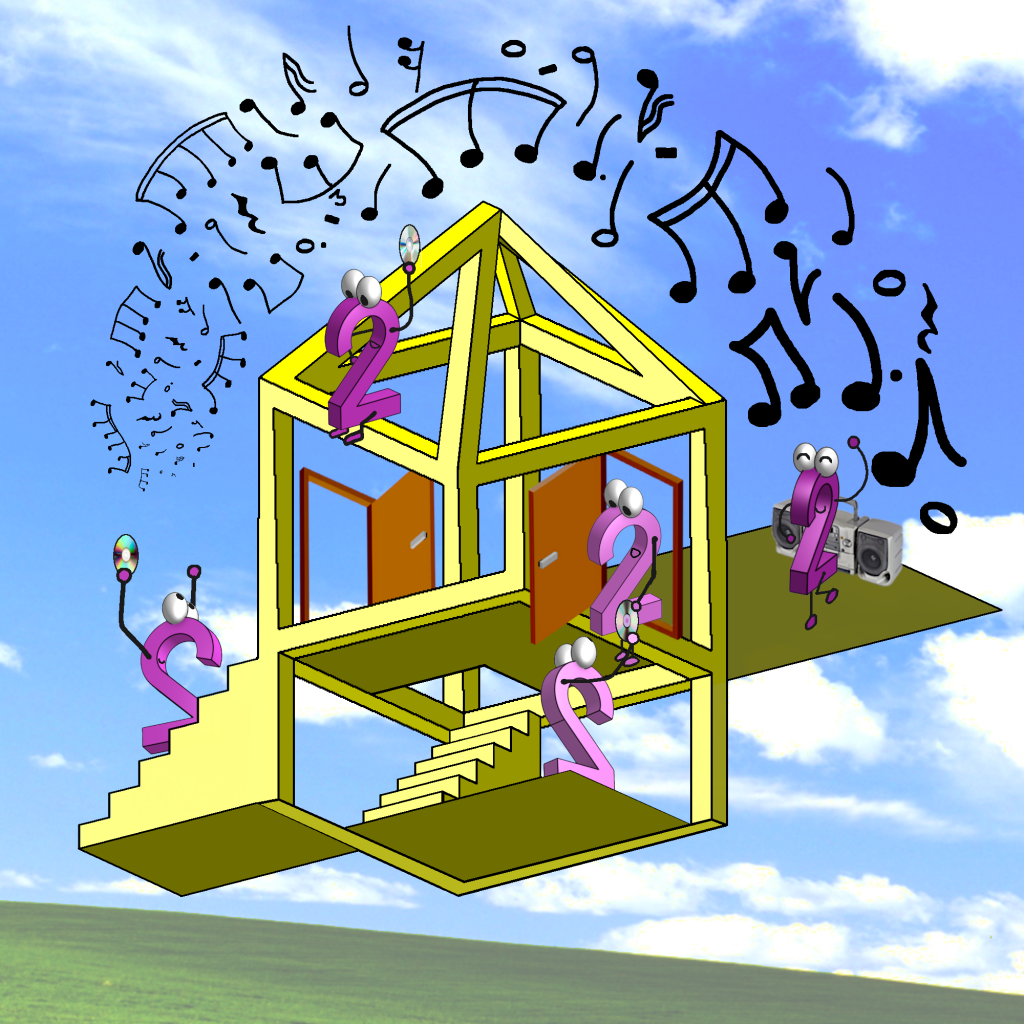
I wanted to make something 2000s retro like with a meme-y twist, so i drew a house out of an impossible cube and went from there, since this is a house song! And i drew in some characters that are also 2s and that look a bit like clippy, which are exchanging CDs on their little party to make the retro vibe stronger.
And finally, making this cursed impossible house float through the skies above a Windows XP landscape just felt right 😀
Machina Soni
I made this song as a genre fusion between electronic music and metal, which represents the collision of two vastly different worlds of alien like sounding dubstep synths and heavily distored electric guitars. The song explores the fact that humans are driven to build musical instruments since the cavemen times and use music to bond with other humans. So what if we could use music to bond with extraterrestrial life as well? That is what the story of this song is all about, building instruments, making music and being exited to share it with whatever is out there in the vast and hostile expanse of space. That is, in a fictional setting where aliens exist and music is a constant of life.
This song is not that musically complex, but i composed it with a weird melody line that goes from on beat to syncopated and back to on beat in the first half of the song which leads to some wonky headbanging XP But apart from that, nothing too special is going on. The song is more focused on blending electronic and distorted guitar sounds together which was quite the mixing headache…
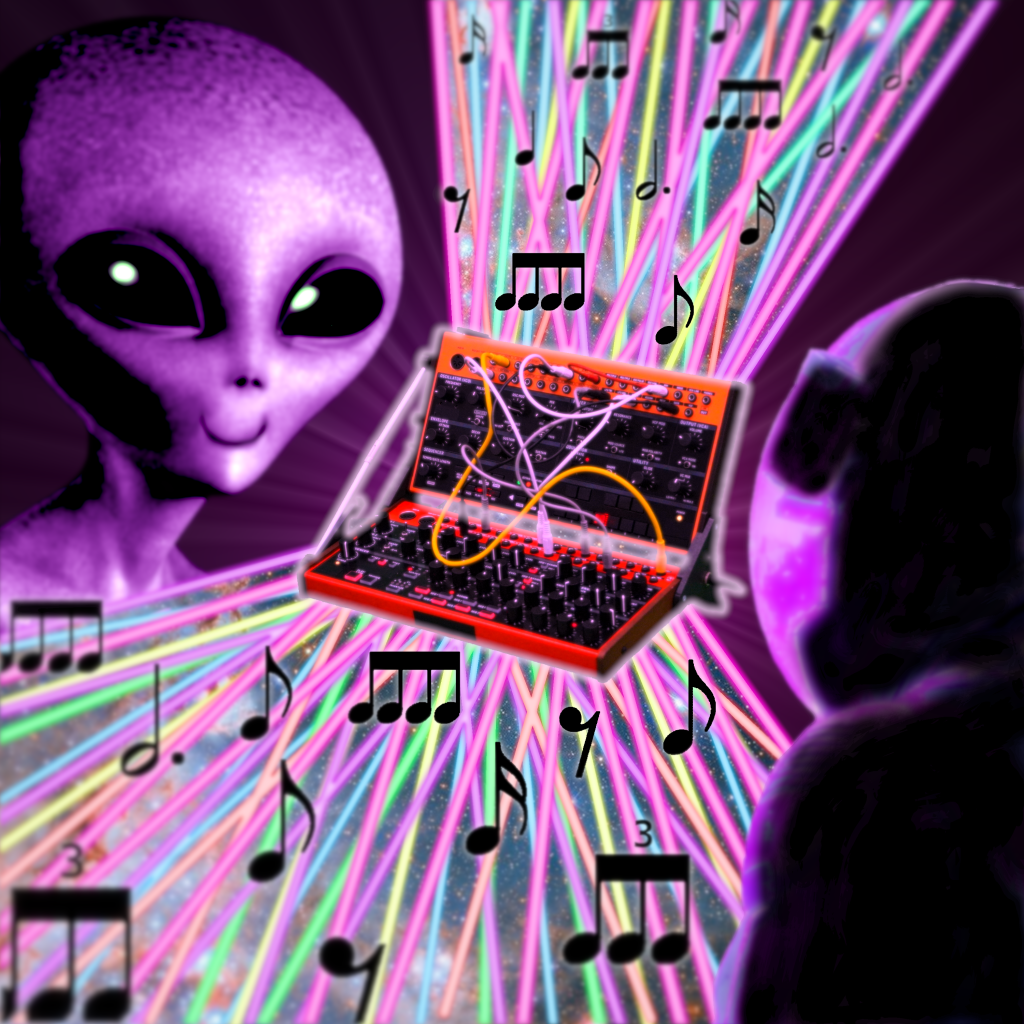
The title art shows a fictional and meme-y scene where a human and an alien are totally vibing and bonding over music, where perceiving sound and making music are assumed to be constants throughout all complex intelligent lifeforms. The synthesizer in the picture is part of a folding battery powered jamstation that i built which got me the idea for the concept of this song.